Architect


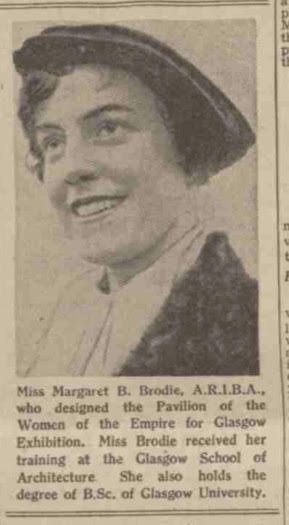
The Architect, Margaret Brodie, has much to be recognised for! Born in 1907 in Largs, she was one of three daughters of John and Jane Brodie. John, her father was a civil engineer with offices in Park Circus. Her parents, who were usually enlightened for the time, wanted to ensure that their daughters were given the same educational opportunities as the male students. She studied at Glasgow High School for Girls before obtaining a place on the Architectural Course at the Glasgow School of Art. Brodie was one of the first few women in the 1926 cohort to study on the BSc Arch course. She passed her degree with First Class Honours for her BSc at Glasgow University in 1928.
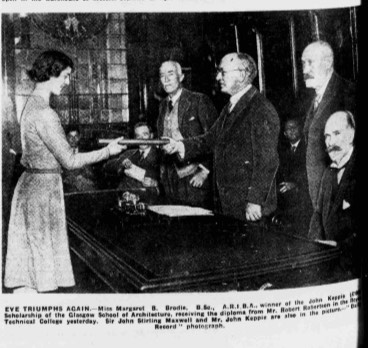
In 1930 she won the GSA John Keppie Scholarship of £100 for the best scholar of the year. Brodie was one of the first fully-qualified women architects in Scotland.
After graduating , she was lucky enough to be employed in the London Office of Sir John Burnet, Tait and Lorne, one of Britain’s most successful inter-war-architectural practices. And one of her first tasks, for the firm, was to work on the detail of Thomas Tait’s drawings for the Infectious Diseases Hospital in Paisley, which was said to be one of the most advanced hospitals in Europe at the time.
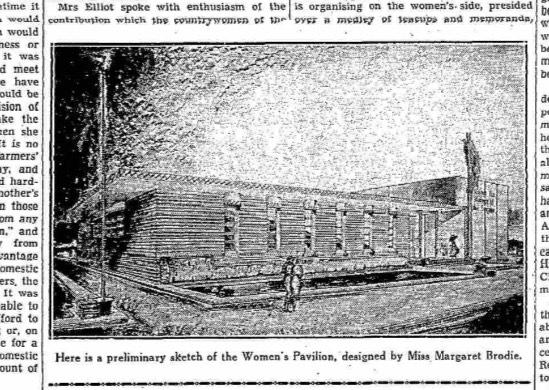
Brodie’s next large scale-project would be two years later in 1938, when she would work on ‘Tommy Tait’s….. most celebrated project’ – the 1938 Glasgow Empire Exhibition. Originally, not designed to have a ‘Women’s Pavilion’ but instead a ‘Fashion Pavilion’, the 15,000-square-foot Pavilion was undertaken by Brodie who was undaunted by the task and stated that she had the time of her life’ designing the building’.
In 1945 Brodie established her own architectural practice and much of her latter work was with the Church or Scotland, either designing new churches or advising on the restoration of existing buildings. Her works from this time include Christ Scientist Church, Helensburgh, St Martin’s Church in Port Glasgow (1956) and Laurieston Church in the Gorbals. She also designed the Grants Distillery in 1962.
By reading accounts, ‘Miss Brodie’ or ‘Miss Margaret’ as she was known in her Renfrewshire village of Lochwinnoch where she lived in Mill House, was quite the eccentric character. She was known for her style, classic country woman, and her appearance was commented on by the newspapers at the opening of the Empire Exhibition.
Brodie succeeded in a competitive and male-dominated field, winning several awards and Honours over her career, including being created a Fellow of Glasgow School of Art in 1995 at a special graduation to mark the school’s 150th anniversary. She is, however, on the record as stating that she strongly detested the notion of feminism. I’ll conclude this post with her advice to the younger female generation – ‘Never be a feminist, that’s important.’
Works:
Women’s Pavilion, Empire Exhibition (1938)
St Martin’s Church, Port Glasgow (1956)
Grants Distillery, Grangestone, Girvan (1963)
 Karen Mailley